
Asian Needle Ants in North Carolina: How to Identify, Avoid, and Control This Invasive Stinging Ant
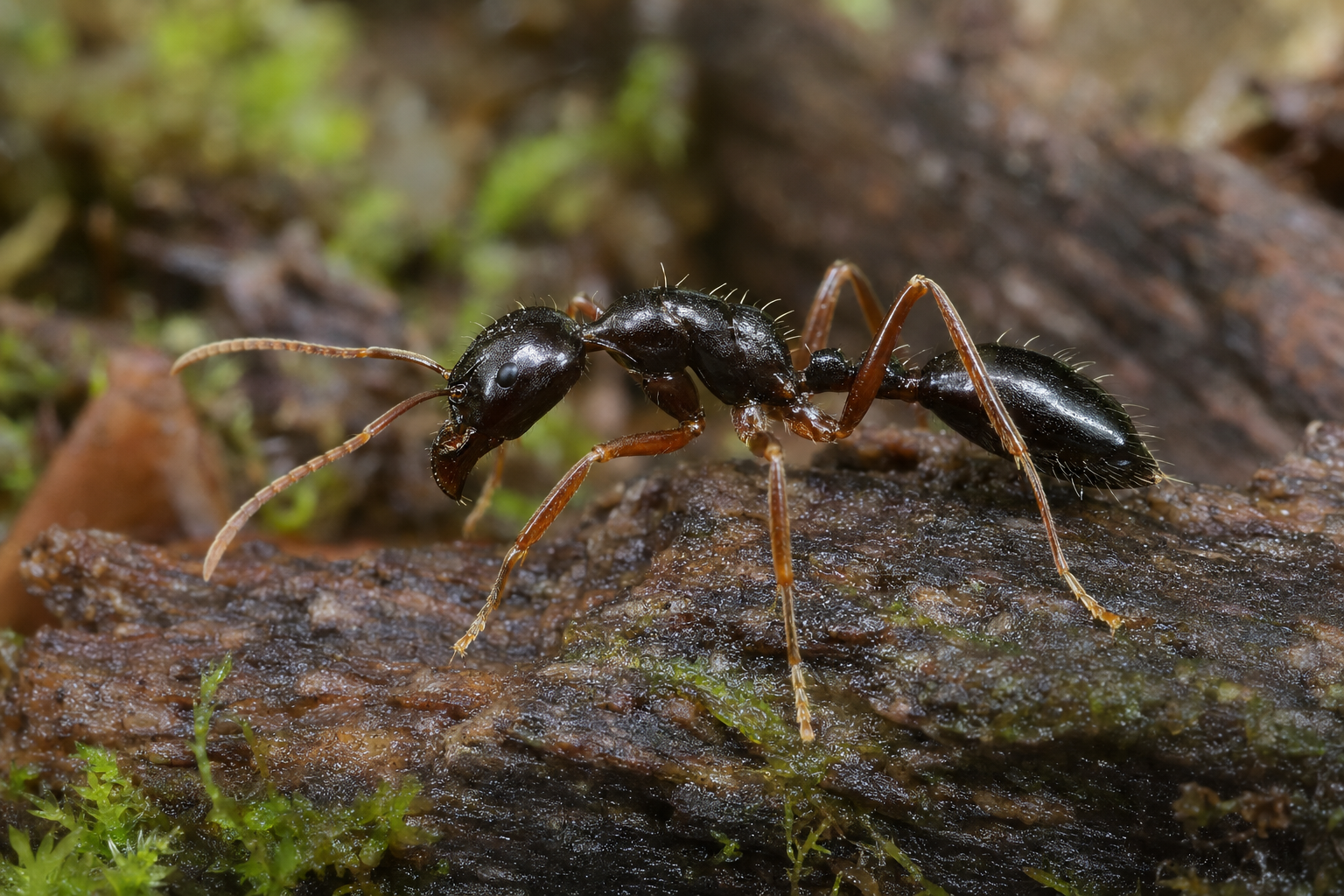
No mound. No trail. Ninety years in this state and most people have still never heard of it.
Most invasive species announce themselves. Kudzu eats a hillside. Fire ants throw up a mound you can spot from the driveway.
The Asian needle ant does neither, which is a big part of why it has spent almost a century spreading through North Carolina without much fuss.
You have probably walked past one already. A single dark ant crossing a paver, going nowhere in particular, no line of friends behind it. That solitary wandering is the tell. And if you garden, spread mulch, or move firewood, it is worth learning to spot, because this one stings, and for a small number of people that sting ends in an emergency room.
So What Is It, Exactly?
Brachyponera chinensis. Native to Japan, China, and the Korean peninsula. Older sources call it Pachycondyla chinensis, which is the same insect under a name that got retired in 2014, so don't be thrown if you turn up an older extension bulletin.
It landed in Decatur, Georgia around 1932. Then, essentially, nothing happened for seventy-odd years. Entomologists didn't start treating it as a real pest until about 2006. Now it turns up in most of North Carolina's 100 counties and in roughly two dozen states.
Here is what makes it a harder problem than the invasive ants we already live with. Fire ants and Argentine ants need us. They do their best work on ground people have already torn up: roadsides, new subdivisions, the strip between sidewalk and curb. Asian needle ants are perfectly happy there too, and they also move into intact hardwood forest, which almost no other invasive ant pulls off. The NC State Extension publication on the species makes this point clearly, and it's the reason containment is so difficult.
Their colonies are small, too. Sometimes under a hundred workers, rarely more than a couple thousand, and often with several queens sharing the nest. Small colonies are half the reason nobody notices them until someone gets hurt.
How to Identify an Asian Needle Ant
What it looks like
- About a fifth of an inch long, roughly 5 mm. Smaller than a carpenter ant, bigger than the little sugar ants in your kitchen.
- Shiny, dark brown to black body with rusty orange legs, mouthparts, and antenna tips. That orange is the giveaway once you know to look for it.
- Long and slender. Next to a typical yard ant it looks stretched out, almost wasp-like.
- A stinger at the rear of the abdomen, visible when the ant is using it.
What it does, which is honestly the better clue
- It builds nothing you can see. No mound, no crater, no obvious entrance.
- It doesn't lay scent trails, so you won't get that neat single-file line across the patio.
- One worker will physically pick up another worker and carry it to food. If you spot an ant hauling another ant, stop and look closer. Very few species do this.
- It can't climb glass. Its feet don't grip smooth surfaces, so an ant dropped into a jar generally can't get back out.
That said, plenty of ants look roughly like this, and even the specialists admit that confident identification takes practice. If you want to compare against good reference photos, the NC State entomology fact sheet and the Missouri Department of Conservation field guide are both solid.
Where They Turn Up in North Carolina
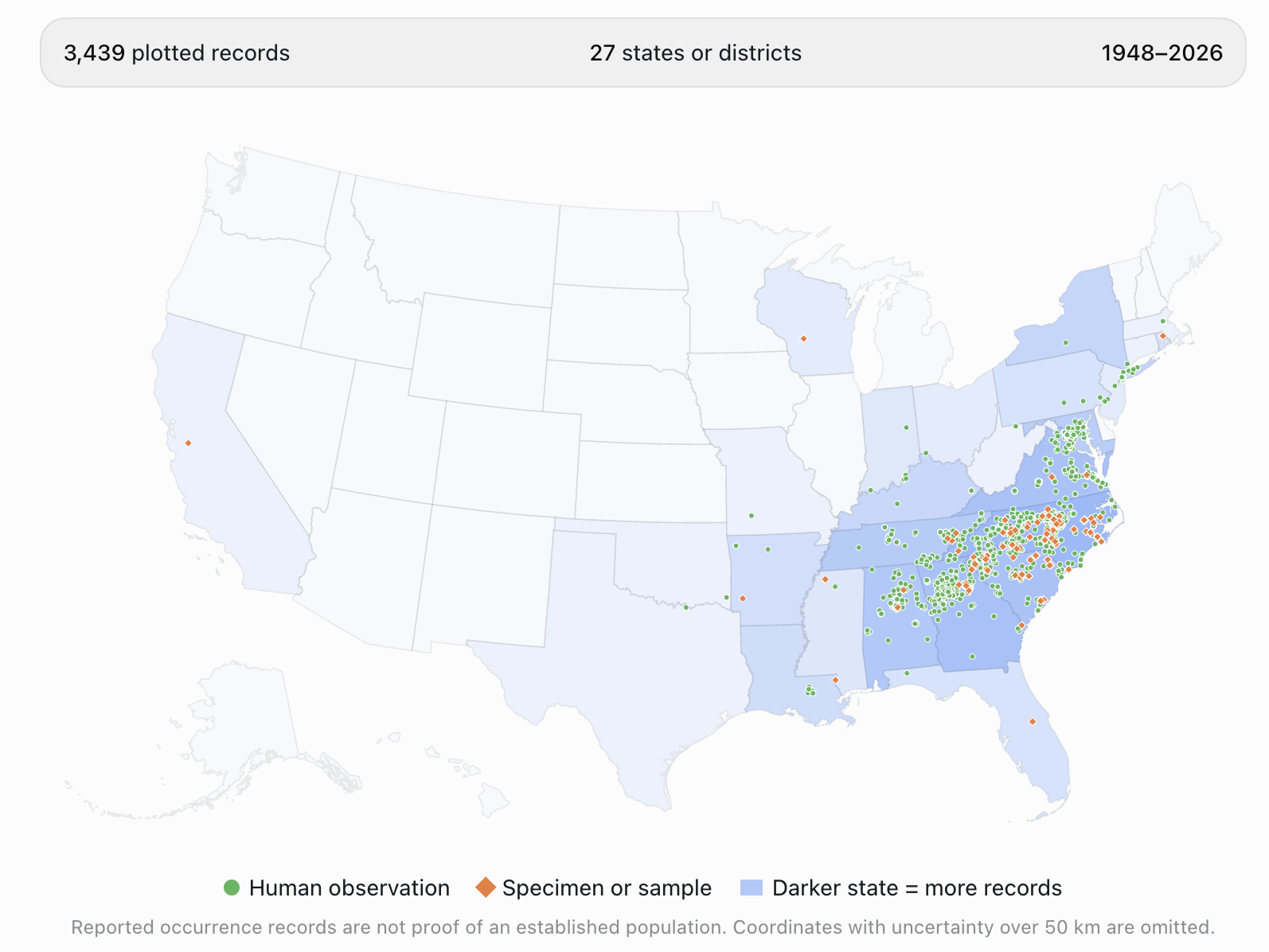
Mountains to coast, at this point. Extension offices out west in Cherokee and Clay counties have both put out advisories, and Piedmont and coastal-plain residents report them regularly. A fair amount of the original American research on this ant was done right here in North Carolina.
Around a house, they want damp, shaded, and left alone:
- Mulch and pine straw, especially the beds pushed up against a foundation
- Under pavers, stepping stones, landscape timbers, loose bricks, railroad ties
- Rotting logs, old stumps, and stacked firewood
- Underneath flowerpots, tarps, kiddie pools, anything flat left sitting on wet ground
If you live where the mulch never fully dries out, which describes a lot of coastal and southeastern North Carolina, that list covers most of the average yard.
Here in the New Bern area, we've been finding Asian needle ants under mulch beds, landscape timbers, and around older crawlspace foundations — especially in the shaded yards near the Croatan National Forest and along the Neuse River corridor.
Numbers peak in mid to late summer. The winged reproductive ants fly roughly April into September, heaviest from late spring into early summer.
The Sting, and Why Entomologists Started Paying Attention
These ants are not aggressive. That's the confusing part. They don't boil out of the ground the way fire ants do, and they aren't hunting you. Nearly every sting happens because the ant got trapped against skin: inside a glove, under a waistband, pinned flat when somebody rolled a log over.
Benoit Guénard, who studied the species in North Carolina, has described the sensation as a needle going straight into the flesh. Sharp, very localized, and capable of flaring back up for half an hour or more.
For most people, that's the whole experience.
For a minority it isn't, and that's why extension entomologists have started using the phrase "medically important pest." The venom looks somewhat more likely than honey bee venom to set off a systemic allergic reaction. A survey in an infested region of South Korea found that roughly 2% of people who were stung had a systemic reaction, with about half of those progressing to anaphylaxis, and the risk ran highest among people who had been stung repeatedly over the years. Guénard collected voluntary reports while he was working in the U.S. and logged severe reactions across Georgia, both Carolinas, Tennessee, Kentucky, Mississippi, and Washington, D.C. Dan Suiter at the University of Georgia fielded three separate anaphylaxis calls in one year.
If you get stung
Pain, redness, and swelling right at the sting that fade within a few hours is the normal reaction. Clean it, use a cold compress, keep an eye on it.
Get emergency help immediately for anything systemic: hives spreading past the sting site, swelling of the face, lips, tongue, or throat, trouble breathing, chest tightness, dizziness, vomiting, or feeling faint. Anaphylaxis can move fast.
Already carry an epinephrine auto-injector for bees, wasps, or fire ants? Keep it on you during yard work and mention needle ants to your allergist. There's no way to know ahead of time whether you'll react.
None of this is medical advice. If you're unsure, call 911.
The Part That Gets Less Attention: What They Do to the Woods
The sting is what makes the news. The ecological damage is arguably worse.
Asian needle ants are predators with a real appetite for termites, and they push native ants out of the neighborhood. In one long-running study of infested habitat around Athens, Georgia, roughly 60% of the native ant species disappeared locally over about a decade.
NC State researchers have also watched them displace Argentine ants, which is grimly impressive, because Argentine ants are one of the most successful invaders on the planet. The needle ants simply wake up earlier in the spring and get a head start on nesting.
You might reasonably ask why it matters which ants win. It matters because a lot of our woodland wildflowers hire ants to plant their seeds. Trillium, bloodroot, violets, Dutchman's breeches. The seeds come with a fatty little attachment, an ant carries the whole thing back to the nest, eats the snack, and discards the seed somewhere it can actually grow. Pull the native ants out and that arrangement quietly falls apart.
How to Control Asian Needle Ants Around Your Home
First, set expectations. You manage these ants. You don't eradicate them.
Second, know why the bait from the hardware store often disappoints. Trail-forming ants pass food around the colony quickly, so a little poison spreads fast. Needle ants use that odd carry-your-coworker system instead, so bait moves through the nest slowly and inefficiently. Protein-based baits have performed better, and NC State has been working toward formal treatment recommendations.
Habitat changes that genuinely help
- Pull mulch, pine straw, and leaf litter back a few feet from the foundation and keep that band thin and dry.
- Get firewood, scrap lumber, loose pavers, and bricks up off the soil.
- Clear out rotting stumps and logs where you reasonably can. These are prime nesting real estate.
- Fix the leaky spigot, the downspout dumping against the wall, the irrigation head soaking one corner of the bed.
- Caulk foundation cracks, gaps around windows and doors, and utility penetrations. A colony nesting outside will still forage indoors.
- Keep food sealed inside. The real indoor risk isn't the food loss, it's someone getting stung reaching for it.
Personal precautions
- Gloves for gardening, mulching, and moving wood or stone. Most stings come from an ant pressed against skin.
- Shake out gloves and boots before you put them on.
- If one's crawling on you, flick it off. Don't brush it or press it.
- In late spring and early summer, winged females land on people and drop into swimming pools. Worth knowing before it happens.
If they're established, call a licensed pest management professional and say specifically that you suspect Asian needle ants. It isn't a routine ant call and the approach differs. Learn more about our ant control services or contact us for pest control in New Bern.
Reporting a Sighting in North Carolina
There's no federal agency keeping a comprehensive database on this species, which means county-level reports carry more weight than you'd expect. If you think you've found them:
- Collect one safely if you can. A smooth glass or plastic jar works, since they can't climb out. Freezing preserves the specimen.
- Photograph it next to something for scale.
- Call your local N.C. Cooperative Extension county center for identification.
- Note the date, the location, and what it was nesting in or under.
Questions People Keep Asking
Are Asian needle ants in North Carolina dangerous?
For most people, no. A sting hurts and then it's over. The concern is that the venom can trigger a systemic allergic reaction, including anaphylaxis, in a small percentage of people, and there's no way to know in advance whether you're one of them. If you already have an insect sting allergy, take them seriously.
What's the difference between an Asian needle ant and a fire ant?
Fire ants build obvious dirt mounds, swarm when you disturb them, and sting repeatedly. Asian needle ants build nothing visible, wander alone instead of in trails, and sting only when trapped against skin. Fire ants are reddish brown. Needle ants are dark with orange legs. If you are dealing with mounds, check out our fire ant control services.
Where do they nest?
Damp, shaded, undisturbed places. Under mulch, leaf litter, stones, pavers, landscape timbers, flowerpots, and firewood, plus inside rotting logs and stumps. They also nest in undisturbed forest, which is unusual for an invasive ant.
When are they most active?
Populations peak in mid to late summer, though the ants get moving earlier in spring than most species. Winged reproductives fly roughly April through September, heaviest in late spring and early summer.
Do regular ant baits work?
Often not well. Their slow, one-ant-carries-another foraging style means bait spreads inefficiently through the colony, so typical sugar-based household baits underperform. Protein-based baits do better, and combining baiting with habitat cleanup beats either one alone.
How many states have them?
Roughly two dozen, concentrated in the Southeast and Northeast, with scattered records as far out as Wisconsin, Texas, Oregon, and Washington. The range is still growing.
None of this is a reason to stay out of your own yard. Wear gloves when you're in the mulch. Keep the beds pulled back from your foundation. Learn what the ant looks like, and learn what a systemic allergic reaction looks like so you can move fast if it ever happens to someone you're with. That's most of the defense right there.
The quiet, mound-free, trail-free behavior is exactly what let this ant reach nearly every county in North Carolina without anyone noticing. Paying a little attention undoes most of that advantage.
If you've spotted what you think might be an Asian needle ant in your yard, snap a photo and give us a call at (252) 633-1719. We're happy to help identify it and recommend a plan if treatment is needed.
Sources and Further Reading
- NC State Extension — Asian Needle Ants in North Carolina: What to Know
- NC State Extension Entomology — Asian Needle Ant fact sheet
- NC State Extension Publications — Asian Needle Ant Around the Landscape and Home
- USDA Forest Service — Asian Needle Ant: An Invasive Stinging Ant (Science Update SRS-SU-143, PDF)
- USDA Forest Service Treesearch — publication record for the Science Update
- NC State University News — Needle Ant Invasion Spreads Coast to Coast
- CBS News — What to know about Asian needle ants and their potentially fatal sting
- WRAL — Dangerous Asian needle ants invading North Carolina neighborhoods
- N.C. Cooperative Extension, Cherokee County Center — Asian Needle Ants Found in NC
- N.C. Cooperative Extension, Clay County Center — Residents Urged to Watch for Invasive Asian Needle Ants
- Mississippi State University Extension — Pest Snapshot: Asian Needle Ant
- Missouri Department of Conservation — Asian Needle Ant field guide
- AntMaps.org — global distribution records for Brachyponera chinensis
- Newsweek — map of U.S. states where Asian needle ants have been detected
- N.C. Cooperative Extension — find your local county center
Disclaimer: General information only, not medical advice. If you have symptoms of a severe allergic reaction after an insect sting, seek emergency care immediately. Pesticide recommendations change; follow label directions and check with your local Cooperative Extension office or a licensed pest management professional.